
Thirty-two years after the project was sanctioned, the first indigenously-built Tejas Light Combat Aircraft was on Saturday handed over by Defence Minister Manohar Parrikar to the Indian Air Force, a red letter day for Indian defence and aerospace sector.

India's first light combat aircraft is the effort of 40 laboratories, 25 academic institutions and 300 companies.
In a last-minute twist, General Electric of the US has bagged the hotly contested $800-million tender to supply 99 engines for India's Tejas light combat aircraft (LCA). After both engines in the contest -- GE's F-414 and Eurojet's EJ-200 -- were found technically suitable, the F-414 has been declared the cheaper option.
Flown by Group Captain A P Singh, the aircraft covered an altitude upto 11 km and supersonic speed of Mach 1.1, DRDO said in its release.

Officially named Tejas, the aircraft has undergone over 1,000 hours of test flights.

Indian Air Chief Marshal Amar Preet Singh and Japan Air Self-Defence Force (JASDF) Chief of Staff General Takehiro Morita took off from Air Force Station Jodhpur in Tejas aircraft on Sunday during the ongoing Indo-Japan bilateral air exercise 'Veer Guardian-2026'.

The Indian Air Force (IAF) is establishing a maintenance facility for GE Aerospace's F404-IN20 jet engines, which power the Tejas light combat aircraft, with technical support from GE Aerospace. This initiative aims to enhance India's indigenous defence capabilities and reduce reliance on overseas repair centres.

The Indian Air Force's Tejas light combat jets are scheduled to return to the skies next week after being grounded for two months due to a software glitch. HAL expects to deliver over 20 Tejas Mark 1A variants by December, but delays persist due to engine supply issues.

Air Chief Marshal AP Singh has voiced concerns over significant delays in inducting new combat jets, including the Tejas aircraft, which are impacting the Indian Air Force's depleting fighter squadron strength. He stressed the need for annual induction of 36-40 jets to address the gaps and discussed ongoing procurement plans like the MRFA deal and future strategies for combat aircraft and theatre commands.

The delivery of the jets are facing delays primarily due to GE Aerospace missing several deadlines for supply of its aero engines to power the jets.

HAL has handed over a new batch of indigenous aircraft, marking another step in India's domestic aerospace manufacturing programme. The company delivered two LCA Tejas FOC twin-seater trainers to the IAF, completing twin-seater deliveries under the FOC contract.

Air Chief Marshal AP Singh, Chief of Air Staff, has expressed significant concern over the inordinate delays in inducting new combat jets, including the indigenous Tejas aircraft, stating that these delays are severely impacting the Indian Air Force's depleting fighter squadron strength. He highlighted the need for 36-40 new fighter jets annually to address these gaps and voiced worry over Pakistan's collaboration with China on a fifth-generation fighter jet.

The pilot ejected safely and a court of inquiry has been ordered to ascertain the cause of the accident, the IAF said in a brief statement.

The defence ministry said 98 per cent of the total procurement worth Rs 2.23 lakh crore will be sourced from the domestic industries.
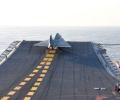
On Saturday, the aircraft made its first landing on the deck of INS Vikramaditya which was also a major milestone. Both the landing and take off by the aircraft put India among a select group of nations having the capability to design such a jet which can operate from an aircraft carrier.
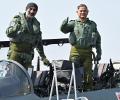
This was the first time two chiefs of the armed forces undertook a flight together.
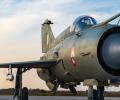
The Indian Air Force (IAF) is set to retire its MiG-21 aircraft in September after over six decades of service. The last of the MiG-21 jets will be given a farewell at a ceremony in Chandigarh.

India's indigenous fighter jet programme reached a key milestone on Friday, October 17, 2025, as the Tejas Mk1A made its maiden flight at Hindustan Aeronautics Limited's Nashik facility.

The slippage in the delivery schedule for the LCA Mk-1A variant of the jet had become a major issue with Chief of Air Staff Air Chief Marshal A P Singh raising the matter publicly.
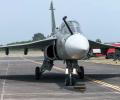
HAL executives said deliveries of the Tejas Mk1A to the IAF would begin within this year, but only after the successful completion of the weapons-firing trials currently underway.

According to an international media report, the jet crashed in the afternoon local time while flying a demonstration flight at the prestigious air show.
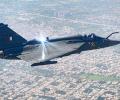
'The aircraft is expected to be ready for rollout between January and March 2026, and to fly by the end of the year.'

The political confidence required to place high-end Japanese aircraft and personnel on Indian soil is itself a data point.
It indicates a level of trust that would have been difficult to imagine when India-Japan defence ties were largely symbolic, explains Varun Arya.

Hindustan Aeronautics Ltd (HAL) expressed deep sorrow over the death of an Indian Air Force pilot, Wing Commander Namansh Syal, in a Tejas aircraft crash during an aerial display at the Dubai Air Show. The incident involved the indigenous Light Combat Aircraft (LCA) Tejas and marked the second crash involving a HAL-manufactured aircraft in 20 months.

On Wednesday, August 23, 2023, Tejas, the Light Combat Aircraft LSP-7, successfully fired the ASTRA indigenous Beyond Visual Range (BVR) air-to-air missile off the coast of Goa.

In the phone conversation on Tuesday, Singh urged Hegseth to expedite the delivery of GE F404 engines to power the Tejas Light Combat Aircraft, people familiar with the matter said.

The participation of the three vice chiefs in the Tarang Shakti exercise demonstrated the growing focus on cross-domain cooperation, with land, sea, and air forces working together to face modern challenges, an official said.
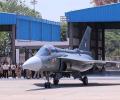
HAL has assured the IAF that 12 Mk1A aircraft will be delivered by the end of 2025-2026.

On Saturday, July 1, 2023, the indigenous Light Combat Aircraft Tejas will complete seven years of service in the Indian Air Force.
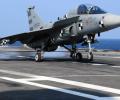
The naval version of Tejas light combat aircraft is in development stage. Officials said the successful "arrested landing" of the prototype of the naval version of Tejas on the deck of INS Vikramaditya is expected to speed up development of the jet for the Indian Navy.
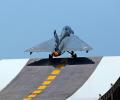
The Indian Navy has ruled out deploying indigenously built light combat aircraft Tejas on its aircraft carriers, saying it is "not being able to meet the requirements".

Built as an expendable, short-duration turbojet engine for single-mission applications, it can power tactical cruise missiles, anti-ship missiles, and long-range loitering munitions.
The test flight lasted 24 minutes.

India has accumulated experience organically and in public, through blood, sweat and toil -- one commissioning and one agreement at a time -- and is called a regional power. China has accumulated hulls, by misdirecting its industrial capacity, and is mistakenly called a superpower. The Indo-Japan defence agreement pushes this theory to its limits without ever naming the dragon in the room, points out Dr Abhishek Puri.
The Tejas Light Combat Aircraft, which has remained grounded for more than three months, finally resumed flight-testing last week.

According to official figures, 14 squadrons of the MiG 21, MiG 27 and MiG 29 are due for retirement in the next 10 years which will bring down the fighter squadron strength to 19 by 2027 from the current 33.
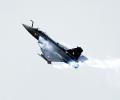
Air Chief Marshal A P Singh and Chief of the Army Staff General Upendra Dwivedi on Sunday set the tone for the grand Aero India-2025 by flying in the Light Combat Aircraft (LCA) Tejas in Bengaluru at Yelahanka based Air Force Station.

The Mark-1A will be more sophisticated and capable than the Tejas Mark-1.
Ajai Shukla spends a day with Tejas test pilots to find out what drives them.
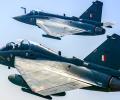
HAL aims to raise output from the current ceiling of 24 aircraft a year to 30 by the end of 2027
